I have a background in history, legal & political philosophy, and statistical anthropology. For my doctoral work, I have applied this to Marxist and post-Marxist political philosophy in Eastern Europe. The subject matter of my work is the history of political thought as written by both historians, philosophers, and social scientists. Using this interdisciplinary approach, I have laid into relief for the first time the main lines of 20th Century Polish philosophy.
My doctoral thesis, Continuities in Pre and Post Marxist Polish Political Thought: Leszek Kołakowski and the Warsaw School of the History of Ideas, provides the first Anglophone treatment of Leszek Kołakowski that integrates his thought into the Polish intellectual tradition: poster boy of Stalinist Poland turned star defector to All Souls College, Oxford. Where Solzhenitsyn provided the most important polemical address of the Soviet Union, it was Kolakowski's Main Currents of Marxism which traced the development of Marxist thought, from its roots in Plato to its adoptions in Marxist-Leninism. In this way, he both indicated how Marx lay within the Western tradition of political thought while also demonstrating how his system had departed from the notion of personality essential to the main line German tradition. In Oxford, he rehabilitated the early Nineteenth-Century German tradition and showed how the Western tradition could continue without departing into Marxism.
My first post-doctoral book project is a comparative study of conceptions of creativity in British and Polish late Cold War thought. There are significant points of overlap between the vision of freedom laid out in T. S. Eliot's work, and that of Tadeusz Krónski in response to the Nazi tyranny of Poland. Unlike the sheerly negative liberty imagined by Isaiah Berlin, these accounts are sensitive to tradition and historical circumstance (the Marxian term for which is, roughly, 'Praxis'), whilst still maintaining the essential spontaneity of the mainline Kantianism in Western thought. In short, my work seeks to go beyond the rudimental contrast of unconstrained liberty, as opposed to constraint, in order to articulate a vision of responsible freedom. The Polish tradition, especially, despite ongoing concern with this question, receives next to no treatment in Western universities. Under the pressures of Soviet occupation, however, Polish philosophical work, unlike that of the free world, was forged under precisely the sort of historical conditions which make their reflections on freedom of enduring interest.
Biography
Born in Connecticut to Polish emigré parents, and then studying History at King's College London, I was exposed to three distinctive ways of imagining the world. Whilst being myself raised in the United States, I have wanted to understand the roots of that political order in the traditions and experiences of my own family. The Soviet experience of my parents, as well as my father's vocation as a Professor of Bioinformatics, served to provide me with two radically external views of culture. I wanted to understand historical events both with the precision of statistical law and with the awareness of the extremely variable and contingent quality of political association. For this reason, I undertook three different masters degrees, all oriented about this imperative: Legal and Political Theory at UCL; History and Philosophy of Science at Cambridge; and then Human Evolutionary Studies again at Cambridge. The scientistic approach to human life is one I find to be fundamentally limited. In the work of Leszek Kołakowski, I discovered a thinker who combined the sensitivities I had acquired with an extended reflection on freedom: that elusive and fragile object for which my parents had left Poland and come to America.
Education
University of Cambridge
University of Cambridge
University of Cambridge
University College London
King’s College London
Works
Books
(in progress) Continuities in Pre and Post Marxist Polish Political Thought: Leszek Kolakowski and the Warsaw School of the History of Ideas.
(post-doctoral book project) Visions of Responsible Freedom against Tyranny: T. S. Eliot's descendants in England and Tadeusz Krónski's legacy in Poland.
Books
Continuities in Pre and Post Marxist Polish Political Thought: Leszek Kolakowski and the Warsaw School of the History of Ideas (in progress)
The history of Poland, more than that of any other Western nation, is one of foreign occupation and of a culture which is continually brought back, by the personal courage of a few, from being snuffed out forever. Polish philosophy, accordingly, has always been concerned with questions of God and of political freedom, above all, because of the peculiar unfreedom to which the country has been subjected. Leszek Kołakowski, the most sophisticated Polish thinker of the 20th Century (alongside Casimir Lewy, the logician), wrote both as the favored son of the Stalinist state and as the renegade who, expelled to the West, carried the knowledge of totalitarianism back to Oxford in the free world. His own response to the Soviet Union was conditioned, therefore, not essentially by the experiences of postwar Western Europe but instead by a little-known school of historians, born in German-occupied Poland and coming to maturity in the 1950s. Separate from the analytic school of Cambridge and, later, Harvard and Yale, these philosophers wrestled with the Soviet experience through the dominant outlook of Continental Europe, which was the German tradition from Goethe through to Hegel and finally Heidegger and Jaspers. My book shows how the work of these philosophers, more overshadowed than their Anglophone counterparts by their nevertheless common enemy, understood the conditions of political liberty and theological meaning within history.
Visions of Responsible Freedom against Tyranny: T. S. Eliot's descendants in England and Tadeusz Krónski's legacy in Poland (post-doctoral book project)
T. S. Eliot's essay, 'Tradition and the Individual Talent' (1919( seeks to articulate a distinction, in art, between randomness and originality. His answer, that of creative play bounded by canonical material, both continued the English school of criticism, begun in Matthew Arnold and Oscar Wilde, and deliberately echoed Edmund Burke's conception of responsible freedom. Eliot's position, which inspired a century of succeeding English conservatives (not least Michael Oakeshott and Roger Scruton), found an unlikely consonance in the Marxist exiles of Stalin's reign. Disillusioned with the Soviet Union as a political nightmare, exiles such as Leszek Kołakowski sought to shed the totalitarian elements of the philosophy of their youth, but to maintain its hostility to merely negative conceptions of human freedom. In the Oxbridge environment of the mid-late century, these moderate and, over time, largely ex-Marxists, came into contact with the English conservative political tradition. The result was a synthesis of political philosophies of freedom which, being a combination of political traditions, is unique in the history of philosophy.
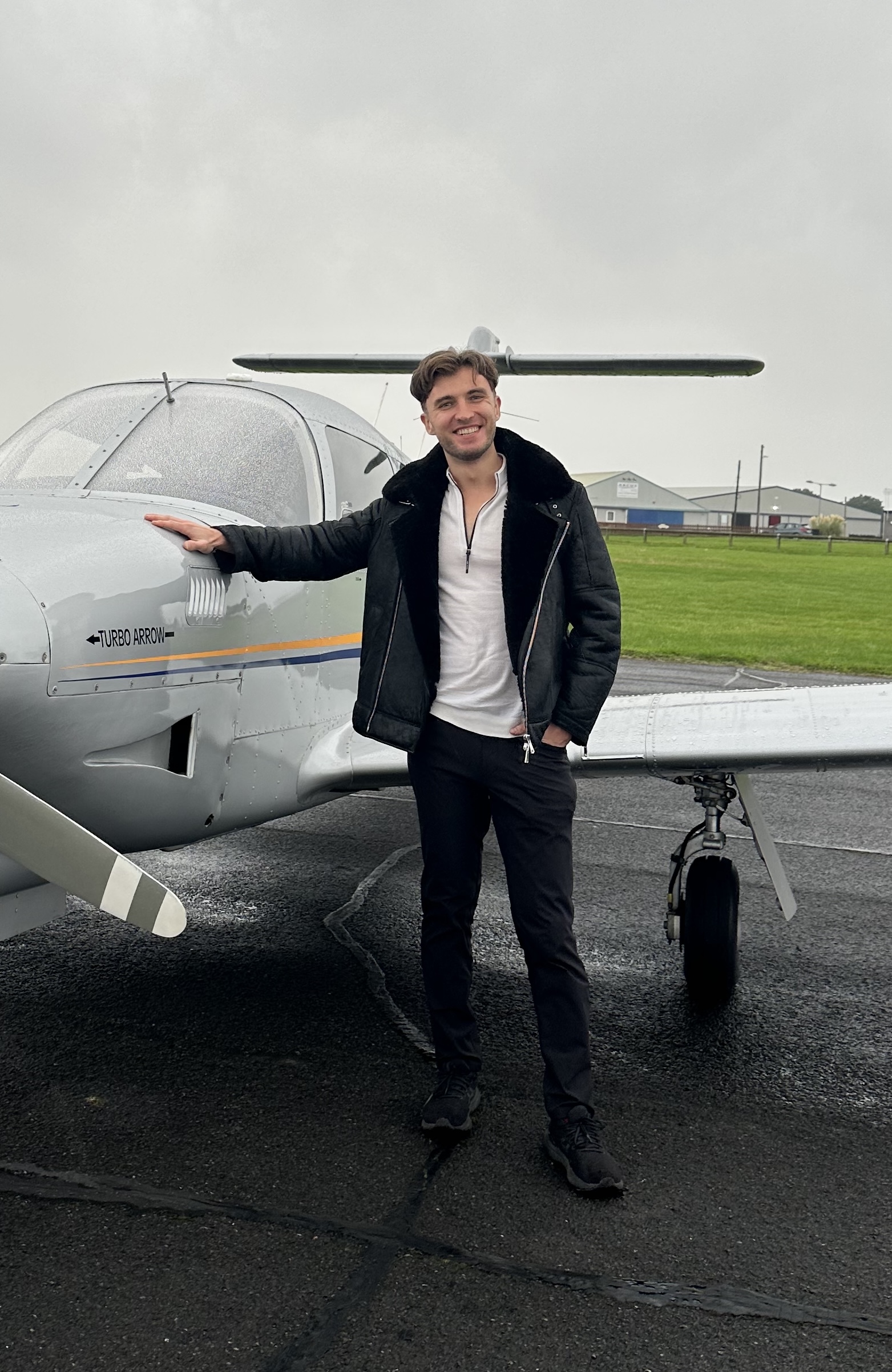
Outside the university, I am a licensed pilot, and occasionally teach flying to fellow academics. I began flying in 2023, and have since flown for over a thousand hours. The art of piloting rests on a technical understanding, but it is itself one of the most palpable expressions of freedom open to experience. I do wonder whether, just as taste for freedom is neither universal nor constant in a human life, the decline of aviation in American public life provides an instructive example. Interest in flight, like interest in freedom, is unswerving for a few but there is quiet ambivalence among most. The philosophical discussion of freedom must regard not only its contents but also those conditions which make it appealing to acquire and to maintain. If one could understand what would motivates one to take an interest in actively flying, I think one would have gone some way towards understanding what makes a people interested in keeping their own liberty.
Licenses
Awards
Landing solo at 108 unique airports within a 20-hour period, beating the previous record of 93 airports. Pending formal ratification with Guinness.